

NOTICE: Book today and get $10 Off a Photo Package! Use code Picture10 at checkout.
What Happens If You Get Stuck on a Zipline?
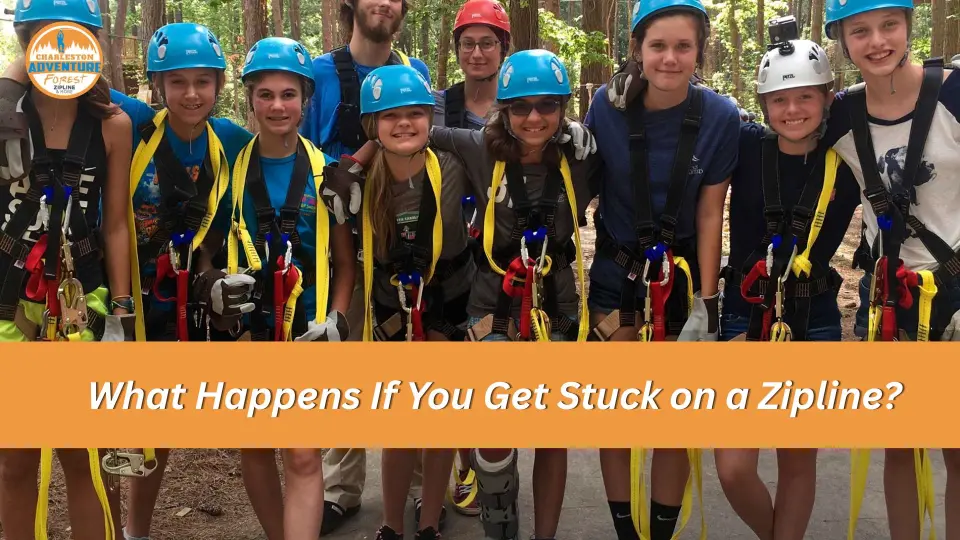
If you get stuck on a zipline, stay seated in your harness, stay calm, and wait for your guide. Do not attempt to pull yourself to the platform. Your harness and trolley keep you completely secure. At Charleston Adventure Forest, guides train specifically for rider retrievals and can quickly assist guests using pull ropes or direct guide support. Most retrievals take only a few minutes, and you'll usually continue enjoying the rest of your tour afterward.
Weather can also affect a rider's speed and momentum. Our guide explains what to expect when ziplining in the rain and when course operations may pause.
Why Do People Get Stuck on a Zipline?
Getting stuck, sometimes called a "mid-line stop," happens when a rider loses enough momentum to stop before reaching the next platform. It is a physics problem, not a safety problem. Several factors can cause it, and understanding them takes the mystery out of the experience.
Not Enough Speed at Launch
The most common cause is a slow start. Ziplines depend on gravity and momentum to carry riders across the cable. If a rider hesitates at launch, sits back into the harness too early, or leaves the platform with a gentle push rather than a confident step off, they may not generate enough initial speed to carry them all the way to the next anchor point. Most guides watch for this and will coach you on a clean launch before you go.
Body Position and Weight Distribution
How you hold your body during the ride matters more than most people expect. Riders who cross their legs tightly, hunch forward, or create unnecessary drag by dangling their feet can lose speed mid-line. The recommended position is legs extended, body relaxed, arms resting on the trolley. This keeps your profile streamlined and maintains momentum across the full length of the cable.
Wind and Weather Conditions
A strong headwind blowing directly into a rider can slow momentum significantly, especially on longer lines. This is more likely to affect lighter riders who have less natural momentum to begin with. Most professional courses monitor conditions throughout the day and adjust operations accordingly, but a sudden shift in wind mid-tour can still catch anyone off guard.
Course Terrain and Line Angle
Not every line on a multi-zip course has the same angle of descent. Some lines are longer and flatter, which means they rely more on the rider's initial speed to complete the crossing. Courses designed by professional engineers account for this, but it is part of why guides brief you differently depending on the line you are about to take. A 750-foot finale line has different physics than a shorter connector line earlier in the tour.
Who Is Most Likely to Get Stuck?
Anyone can experience a mid-line stop, but certain riders are statistically more likely to encounter one. Knowing which category applies to you lets you prepare for it rather than be surprised.
Lightweight Riders
Weight drives speed on a zipline. Lighter riders, typically those closer to the minimum weight requirement, generate less momentum from gravity alone. This does not mean lighter riders cannot complete a course successfully. Most do, without any issues. It does mean that body position and a confident launch matter more for them than for heavier riders who have natural momentum working in their favor.
First-Time Zipliners
New riders often hesitate at the launch platform. The combination of nerves, a tendency to sit back too early, and an instinct to grip the trolley tightly can all reduce starting speed. First-timers also sometimes tense their bodies during the ride, which increases drag. This is exactly why a thorough safety briefing and attentive guides make a real difference. When you know what to expect and how to hold yourself, you ride cleaner.
Riders Facing Strong Headwinds
Wind is the one factor no rider controls. Someone who rides perfectly, with a clean launch, ideal body position, and optimal weight, can still slow to a stop on a line that cuts directly into a stiff breeze. Guides monitor wind conditions across the course and will adjust launch timing or technique recommendations when needed. On particularly windy days, operations may modify the tour accordingly.
How Common Is Getting Stuck on a Zipline?
The honest answer is that mid-line stops happen at every reputable zipline course, but they are far less common than first-timers expect. They are also far less dramatic.
Operator Perspective
At a well-run zipline operation, guides have retrieval procedures they execute routinely. A mid-line stop is not an emergency and it is not a rare event that catches the staff off guard. It is a known scenario that every guide trains for from day one. The fact that professional operators talk about it openly, train for it consistently, and have dedicated retrieval equipment in place tells you everything you need to know about how seriously they take it and how calmly they handle it.
How Modern Course Design Reduces Stops
Modern zipline course designers engineer lines with momentum in mind. Cable angles, platform heights, and line lengths are calculated to give riders of varying weights enough speed to complete each crossing under normal conditions. Courses also position guides at launch platforms specifically to coach riders on body position and ensure a confident start before anyone leaves the platform. These design and operational choices mean that the large majority of riders complete every line without incident.
What Should You Do If You Get Stuck?
If you slow to a stop before reaching the platform, the right response is simple. It is also the opposite of what instinct might tell you to do.
Stay Calm
You are not falling. You are not in danger. Your harness is attached to the trolley, and the trolley is on the cable. The cable itself is engineered to hold significantly more weight than any single rider or group of riders. Take a breath, look at the scenery around you, and wait. Your guide already knows where you are.
Don't Try to Pull Yourself
This is the most important instruction. Grabbing the cable and attempting to hand-over-hand pull yourself to the next platform is both ineffective and unsafe. The cable is not designed to be gripped bare-handed, and the effort required to pull yourself across a long line is far more than most people can manage. More importantly, it is not necessary. Your guide has a much faster and safer way to get you there. Leave it to them.
Follow Guide Instructions
Your guide will communicate with you directly, either from the platform you departed or from the platform ahead of you. They will tell you exactly what is happening and what, if anything, they need from you. In most cases that is simply to relax, keep your hands clear of the cable, and let the retrieval system do its job. Listen to their instructions and follow them. The process moves quickly when riders cooperate.
How Do Guides Rescue a Stuck Rider?
Guides at professional zipline courses do not improvise retrievals. They follow trained procedures using dedicated equipment. Here is how it works.
Pull Rope Systems
Most professional courses have a pull rope system rigged along or near the zipline cable. When a rider stops mid-line, a guide at the landing platform can attach the rope to the rider's trolley or harness and pull them in. The system is designed to be efficient. It does not require the guide to go out onto the cable, and it moves the rider smoothly and steadily to the platform. This is the most common retrieval method at well-equipped courses.
Guide Retrieval Methods
On some courses, particularly those with specific platform configurations, a guide may use a different approach and move along a secondary safety line to reach the rider directly and assist from there. This varies by course design. What does not vary is the training. Guides rehearse retrieval scenarios regularly so that when one happens during a tour, their response is practiced and calm rather than reactive.
What the Process Looks Like
From the rider's perspective, a retrieval looks something like this: you slow to a stop, the guide at the landing platform calls out to confirm you are okay, they attach the pull line, and you feel a steady, gentle pull toward the platform. There is no jerking, no sudden movement. Riders often describe it as surprisingly undramatic. By the time you step onto the platform, the rest of your group is ready to keep going.
How Long It Usually Takes
Most retrievals take between two and five minutes from stop to platform. Factors that affect the timeline include how far out on the line the rider stopped, which retrieval method is used, and how quickly the rider follows guide instructions. In the vast majority of cases, the group continues the tour with minimal delay. The rider who got stuck continues with everyone else.
Is It Dangerous? What the Safety Equipment Does
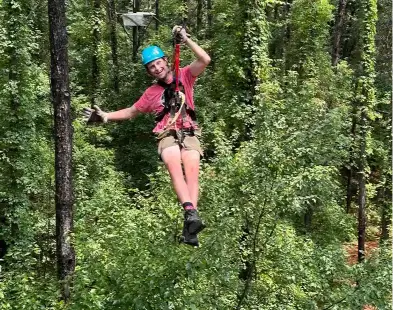
Getting stuck on a zipline feels alarming if you have never experienced it. The reality is far calmer than the imagination. Here is why.
How Harnesses Keep You Secure
A properly fitted zipline harness distributes your weight across your hips, thighs, and torso. When you stop mid-line, you are seated in that harness exactly as you were during the ride. The harness connects to the trolley via a carabiner or similar locking connector rated for loads far exceeding a single rider's weight. You are not hanging by a thread. You are suspended in equipment designed specifically for this scenario.
Why Mid-Line Stops Aren't Emergencies
An emergency is a situation where someone is in immediate danger and time is critical. A mid-line stop is neither. The rider is secure, the equipment is functioning as designed, and the guide has a clear retrieval protocol to follow. The biggest risk during a mid-line stop is a rider panicking and making a poor decision, which is why every reputable operator emphasizes in the safety briefing that the correct response is to stay seated and wait. That guidance exists because it works.
Guide Training and Safety Procedures
Professional zipline guides go through certification training that covers both normal operations and non-standard scenarios including rider retrievals. Reputable operators also conduct internal refresher training throughout the season. This is not background knowledge that guides carry in case something unusual happens. It is an active, practiced skill they maintain precisely because mid-line stops are a known and manageable part of zipline operations.
How Charleston Adventure Forest Handles Rider Retrievals
At Charleston Adventure Forest in Awendaw, SC, guide readiness is built into how every tour runs, not just for emergencies, but for the full guest experience from start to finish.
Guide Training
Every guide at Charleston Adventure Forest is trained in rider retrieval before they lead a tour independently. That training covers the pull rope systems used on the 7-line canopy course, communication protocols between guides stationed at different platforms, and how to keep guests calm and informed throughout the process. Guides are not solo operators. There is always a coordinated team managing the course while a tour is running.
Safety Procedures
The canopy tour course is inspected and maintained to industry standards. Equipment, cables, and retrieval systems are checked regularly, and guides conduct pre-tour equipment checks before each group departs. The 750-foot grand finale line, the longest on the course, is engineered with momentum requirements in mind, and guides brief riders specifically on launch technique before that line to reduce the likelihood of mid-line stops on longer crossings.
What Guests Can Expect
If you stop mid-line at Charleston Adventure Forest, your guide will communicate with you immediately from the nearest platform. You will be told what is happening, what to do, and what the guide is doing. The retrieval will follow a clear, practiced sequence. Most importantly, your tour continues after the retrieval. A mid-line stop is a minor pause in the experience, not the end of it. Guests who experience one routinely tell us afterward that it was less stressful than they expected and that the guides made all the difference.
Our canopy tour runs seven ziplines, three swinging bridges, and up to two hours of guided outdoor adventure through the Lowcountry pines. Every step of that experience, including the rare mid-line stop, is managed by guides who know this course and know how to handle it.
Common Myths About Getting Stuck on a Zipline
A lot of the anxiety around getting stuck comes from misinformation. Here are the three most common myths and what is actually true.
Myth 1: Getting Stuck Means the Zipline Is Unsafe
False. A mid-line stop is a physics event, not a safety failure. The cable is intact, the harness is holding, and the rider is secure. If anything, the fact that professional courses have retrieval systems, trained guides, and briefing protocols specifically addressing this scenario is evidence of safety-conscious operations, not the opposite. An unsafe course would have none of those things in place.
Myth 2: You Will Be Left Hanging for a Long Time
False. Most retrievals at professional courses take a few minutes. Guides are positioned specifically to respond quickly, and retrieval equipment is set up for fast deployment. The idea of dangling helplessly for half an hour while staff scrambles to figure out what to do is not what happens at a well-run operation. It is a fear projection, not a realistic scenario.
Myth 3: Rescues Are Unplanned and Improvised
False. Every reputable zipline operator trains guides for rider retrievals as a standard part of onboarding. The retrieval procedure for a mid-line stop is practiced, equipment-supported, and executed the same way every time. Guides do not figure it out as they go. They follow a process they have rehearsed specifically so that when it happens in front of guests, it looks and feels calm and controlled, because it is.
Ready to Experience Ziplining in Charleston?
Now that you know exactly what happens if you get stuck on a zipline, you can step onto the course with confidence. At Charleston Adventure Forest, our 7-line canopy tour is designed for safety, fun, and unforgettable views of the Charleston wilderness. Whether it’s your first time ziplining or you’re bringing family and friends for an outdoor adventure, our guides will be with you every step of the way from launch to landing.
Book Your Zipline AdventureConclusion
A mid-line stop on a zipline may sound intimidating at first, but in reality it is a normal and well-managed part of zipline operations. At Charleston Adventure Forest, every possible situation is planned for, and our trained guides are always ready to assist you safely and quickly if needed. Most importantly, getting stuck does not mean anything went wrong. The harness keeps you secure, the equipment is designed for safety, and your guides are only a few moments away from helping you continue your adventure. For most guests, it’s a brief pause in the experience not a problem or interruption. Once you understand how it works, you can focus less on “what if” and more on enjoying the ride, the views, and the thrill of exploring the Lowcountry from above.
Frequently Asked Questions
Can you pull yourself to the platform if you get stuck?
You should not attempt this. Pulling yourself along a zipline cable bare-handed is difficult, potentially unsafe, and unnecessary. Your guide will retrieve you using a pull rope system that is faster and safer. Follow their instructions and let the equipment do the work.
Does getting stuck mean the rest of the tour is ruined?
Not at all. After a retrieval you step onto the platform and continue the tour with your group. A mid-line stop adds a few minutes to one line and then the experience moves on. Most guests finish the tour, including the grand finale line, without further incident.
Will it happen on every line if it happens once?
No. A mid-line stop on one line does not predict what happens on the next. Guides will often adjust their coaching after a stop, giving you more specific launch guidance or a stronger send-off, which reduces the likelihood of it repeating. Many riders who stop on an earlier line complete all remaining lines without issue.
Do guides train specifically for retrievals?
Yes. Retrieval training is part of standard guide certification at professional zipline operations. Guides practice the retrieval sequence before they lead tours independently, and reputable operators reinforce that training throughout the season.
Is a mid-line stop more likely on certain lines?
Longer, flatter lines require more initial momentum, so they carry a slightly higher likelihood of a mid-line stop compared to shorter, steeper lines. Guides account for this by giving more detailed launch coaching before those specific lines.