

NOTICE: Book today and get $10 Off a Photo Package! Use code Picture10 at checkout.
Is There a Weight Limit for Ziplining? A Complete Guide

Yes, most zipline operators, including places like Charleston Zipline Adventures in Awendaw, South Carolina, have minimum and maximum weight limits. While requirements vary by location, many courses allow riders who weigh between 60–80 pounds minimum and 250–300 pounds maximum. These limits help ensure riders can safely reach the end of the line and be stopped properly by the braking system.
However, weight is only one part of the equation. Factors such as harness fit, course design, weather conditions, and safety equipment can also affect your eligibility. In this guide, we'll explain how zipline weight limits work, why they exist, and what to do if you're close to the limit before booking your tour.
Zipline Weight Limits Explained (What You Need to Know First)
Before we go further, here are the basics you should know.
Typical minimum and maximum weight limits vary by operator and course design, but the most common ranges are:
- Minimum weight: 70–90 lbs (32–41 kg)
- Maximum weight: 250–275 lbs at many popular venues, with some courses allowing up to 300 lbs or more
These limits are not arbitrary; they are based on each zipline's engineering, including cable tension, braking systems, and course design. They vary between operators because every course is built differently, so there is no universal standard. Weight is also not the only factor — harness fit, body proportions, and safety conditions can all affect whether you're cleared to ride.
Can You Zipline If You're Under or Over the Weight Limit?
Whether you're under the minimum weight or over the maximum limit, your eligibility depends on specific thresholds set by each zipline operator, which we'll break down below.
Children and Younger Riders (Minimum Weight Requirements)
Minimum weight limits exist because lighter riders may not generate enough momentum to complete the course and reach the landing platform, and in some cases may stall mid-line and require staff assistance, which is why these thresholds are set for safety and consistency. Most operators set a minimum weight around 70–80 lbs, and some also offer tandem rides where a child can ride with an adult. Age requirements also typically apply, often between 7–10 years, so both weight and age must be confirmed before booking.
Teenagers and Smaller Riders
Teenagers who meet the minimum weight requirement (typically 80–90+ lbs) and age rules are usually cleared to ride without issues. Smaller adults in the 90–130 lb range also generally qualify, although some may require minor harness adjustments for a secure fit.
Average-Weight Adults
If you fall between 130–220 lbs, weight is rarely a barrier at most zipline courses. You will still go through standard weigh-in and harness fitting, but the process is usually quick and straightforward, with health conditions being more relevant than weight at this stage.
Riders Over 250 lbs
This range requires more attention because policies vary significantly between operators. Many courses set maximum limits around 250–260 lbs, while others allow up to 275 or 300 lbs depending on their equipment. If you are near this range, it's important to confirm before booking. Some operators use specialized harnesses for larger riders, while others enforce strict weight cutoffs with no flexibility.
Riders Over 300 lbs
Courses that accommodate riders over 300 lbs exist but are less common and typically use reinforced harnesses and heavy-duty trolley systems. Because equipment and policies differ widely, contacting the operator directly is essential to confirm whether participation is possible and safe.
Why Zipline Weight Limits Exist
Understanding why these limits exist can make them feel less arbitrary and help you have more informed conversations with operators.
Why Lighter Riders May Not Reach the Landing Platform
A zipline relies on gravity and momentum, and lighter riders generate less of both. On long spans or low-angle cables, a rider below a certain weight may slow down before reaching the end — a situation known as "stalling." Since retrieving a stalled rider can be difficult and time-consuming, especially on remote courses, minimum weight limits ensure riders can reliably complete the run.
Why Heavier Riders Travel Faster
Heavier riders accelerate more quickly and reach higher speeds on the same cable due to greater gravitational force. The concern is not speed itself, but whether the braking system can safely stop a faster, heavier rider within the available distance. Maximum weight limits are therefore based on braking capacity.
Why Braking Systems Determine Safety Limits
Most commercial ziplines use passive (friction-based), active (guide- or rider-controlled), or mechanical/hydraulic braking systems. Each system has an engineering-rated capacity, and exceeding the limit can prevent the brake from stopping the rider safely before the end of the line, creating a serious safety risk.
Why Cable Strength Is Not the Limiting Factor
A properly installed zipline cable is extremely strong and can support far more weight than any rider would ever place on it. The real limitations come from the braking system, trolley hardware, and harness connection points — not the cable itself. This is why some courses can support higher weight limits on shorter or slower lines, while longer or faster courses often have stricter limits.
What Determines If You're Allowed to Zipline?
Weight is a headline factor, but eligibility is assessed across several dimensions.
Weight Verification at Check-In
Most operators weigh every participant at check-in using a scale. This is standard practice and shouldn't be a surprise. The weight recorded typically includes your clothing and any personal items you'll carry more on that below.
Harness Fit and Body Measurements
A harness that doesn't fit correctly is a safety issue regardless of weight. Operators assess waist circumference, thigh girth, and torso length to ensure the harness can be properly adjusted. Some larger-framed riders may find that their body proportions don't fit available harnesses even if their total weight is within the limit. Conversely, some operators carry extended-size harnesses to accommodate a wider range of body types.
Age and Height Requirements
Most operators require riders to be at least 7 years old, and some set higher minimums. Height requirements (typically 48–54 inches minimum) often appear alongside weight minimums and exist for similar reasons to ensure the harness connects correctly and the rider can interact safely with the equipment.
Health and Medical Restrictions
Pregnancy is universally excluded. Heart conditions, recent surgeries, back or neck injuries, epilepsy, and severe vertigo are commonly listed as disqualifying conditions. Operators ask about these for your safety, and honest answers protect you. Many operators include a waiver that requires disclosure of relevant medical conditions.
Weather and Safety Conditions
Lightning, high winds, and severe weather can shut down operations regardless of your eligibility. Always check an operator's weather cancellation policy before booking, and know what your refund or rescheduling options are if conditions deteriorate.
What Happens During Zipline Check-In?

Knowing what to expect helps the process go smoothly.
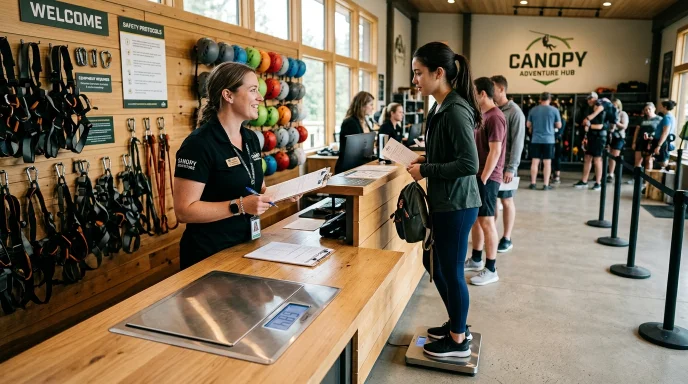
Weigh-In Process
You'll step on a scale — often at a front desk or dedicated check-in station. Some operators do this privately; others do it in a group setting. If privacy matters to you, ask when you call ahead whether they can accommodate a discreet weigh-in.
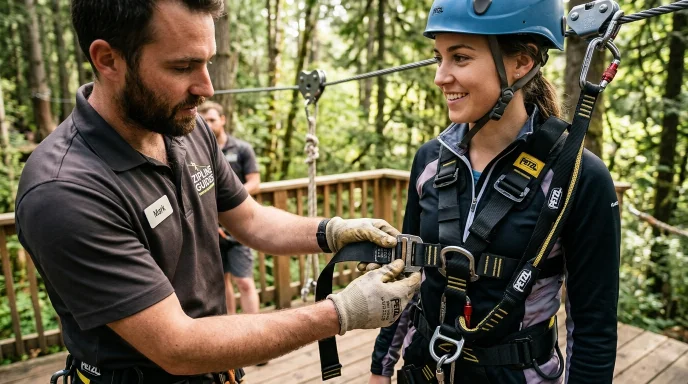
Harness Fitting and Adjustments
A trained guide will fit your harness, checking every buckle, strap, and connection point. This isn't rushed — it's the most important safety step in the process. You'll be asked to move around, squat, and confirm that the fit feels secure without cutting off circulation.
Safety Briefing
Expect a 10–20 minute orientation covering hand positions, body posture during the ride, what to do if you stall, how to use any active braking equipment, and what signals staff will use. Pay attention — this briefing exists because the information matters.
Final Eligibility Confirmation
Even after booking and arriving, a final confirmation happens at this stage. If anything raises a concern — a weight that comes in over the limit once gear is accounted for, a harness that can't be properly fitted, or a health disclosure — the operator will address it here. It's better to catch these issues at check-in than mid-course.
If You're Close to the Weight Limit
If you're near the upper or lower weight limits, a few small factors can make a difference in whether you're cleared to ride.
How Clothing and Gear Affect Your Weight
Shoes, heavy jackets, belts, and even a full water bottle can add 2–5 lbs to your weighed-in total. If you're close to a maximum weight limit, wearing lighter clothing and leaving unnecessary items in your car or locker before weigh-in is a practical step. Don't try to circumvent the limit through deception — but there's nothing wrong with being thoughtful about what you wear to check-in.
Buffer Ranges Some Operators Allow
Some operators build a small buffer into their stated limits — a course advertised at a 250 lb maximum might actually clear riders up to 255 or 260 lbs at a guide's discretion based on harness fit and course conditions. Others have hard stops at the stated number with zero flexibility. You won't know which applies unless you ask.
Why You Should Call Ahead Before Booking
A phone call before booking is genuinely useful if you're near any limit — minimum or maximum. You can confirm exact limits, ask about harness sizing, inquire about tandem options, and understand the refund policy in case you're turned away. This conversation takes five minutes and can save significant frustration on the day.
Key Questions to Ask Operators
- What is your exact maximum weight limit, including clothing and gear?
- Do you carry harnesses for larger or smaller body types?
- Is there a tandem option available?
- What is your policy if I'm turned away at check-in?
- Can I schedule a discreet weigh-in?
If You Don't Meet the Requirements
If you don't meet the standard requirements, there are still several alternative ways to enjoy a zipline experience or similar adventure activities.
Tandem Zipline Options
Some operators offer tandem rides where two people share a trolley — typically a child with an adult, or sometimes two adults together. Tandem setups have their own combined weight limits and availability varies widely. If this applies to your situation, ask specifically rather than assuming.
Courses with Higher Weight Limits
It's worth researching operators in your area or travel destination that specialize in or are specifically known for higher weight accommodations. These courses exist, and they use equipment rated for a broader range of riders.
Alternative Adventure Activities
If ziplining isn't accessible to you on a given visit, consider what else the venue offers. Many adventure parks also run aerial obstacle courses, guided hikes, rappelling experiences, and ropes challenges that have different or no weight requirements. You may still have an outstanding outdoor adventure — just a different one than originally planned.
Refund and Rescheduling Policies
If you're turned away at check-in, you'll want to know your options in advance. Policies vary significantly — some operators offer full refunds if you're disqualified for safety reasons; others offer only rescheduling credits. Review the cancellation policy when you book, and ask the operator directly about what happens in this scenario.
Zipline Eligibility Checklist
Before you show up on the day, run through this list:
- Weight range confirmation — Confirm your current weight (with typical clothing) falls within the operator's stated min/max range
- Harness compatibility — Ask whether the operator has harnesses available for your body size and proportions
- Medical clearance — Verify that no health conditions on your operator's exclusion list apply to you; consult a doctor if uncertain
- Weather policy check — Know the operator's cancellation and rescheduling policy in case of bad weather
- Direct operator confirmation — Call or email to confirm your eligibility before booking, especially if you're near any limit
Secure Your Zipline Experience by Confirming Eligibility First
Still unsure whether you meet the requirements? Before you plan your visit, it's best to contact Charleston Zipline Adventures in Awendaw, South Carolina directly to confirm exact weight limits, harness fit, and any special accommodations. Their team can give you clear guidance so you know exactly what to expect, helping you avoid surprises and enjoy a smooth experience from check-in to your final zip through the Lowcountry forest. Book Now to secure your zipline experience.
Book Your Zipline Adventure at Charleston Zipline Adventures
Frequently Asked Questions About Zipline Weight Limits
Can I zipline at 250 pounds?
Possibly yes. Many operators set their maximum at 250–275 lbs, so 250 lbs is within range for a significant number of courses. Call the specific operator to confirm their limit and harness availability before booking.
Are zipline weight limits strict?
This varies. Some operators have absolute hard limits with no exceptions; others have a small discretionary buffer. Never assume a buffer exists — always confirm with the operator.
Do operators weigh you at the site?
Yes, the vast majority of commercial zipline operators weigh every participant at check-in. This is standard practice and applies regardless of what you reported when booking.
What happens if you get stuck on a zipline?
If a rider stalls mid-line, trained guides will use a retrieval rope or pulley system to bring them safely to a platform. It's a practiced procedure and not a dangerous emergency — but it is inconvenient and exactly why minimum weight limits exist.
Do weight limits include clothing?
Yes. Your weighed-in weight at check-in includes everything you're wearing and carrying. If you're near the limit, lighter clothing and leaving heavy items behind can make a difference of a few pounds.